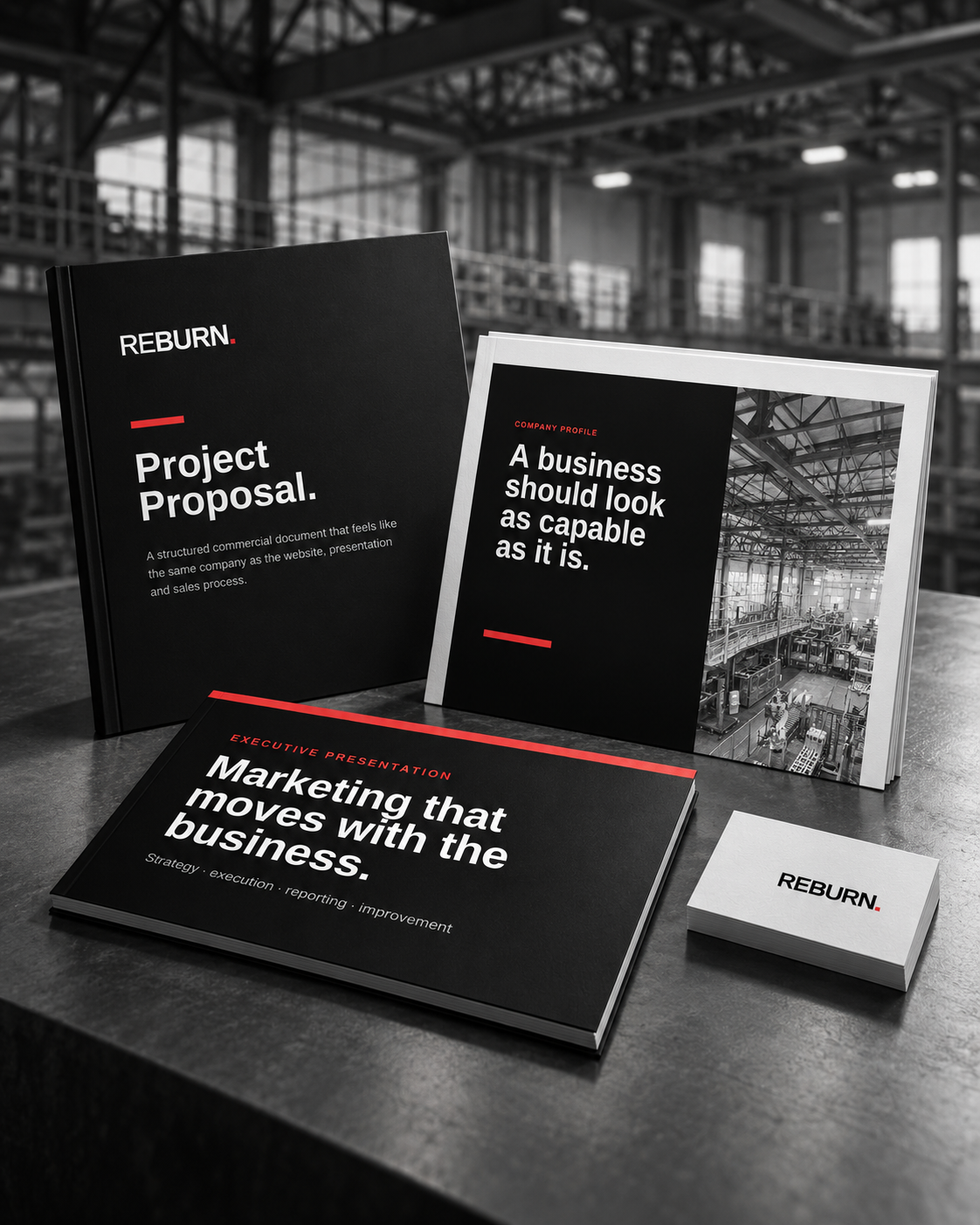
Corporate branding in B2B is the system that makes a business recognisable, credible and consistent across every important touchpoint.
It includes visual identity, but it goes much further than a logo. A strong corporate brand must work across profiles, business cards, presentations, reports, websites, signage, events and customer communication.
Brand architecture, governance and organisation-wide implementation
This page focuses on how an established organisation governs and applies its corporate brand across divisions, documents, suppliers and customer touchpoints. If you need hands-on identity design and creative production, see Branding and Creative Design.
The issue is usually application, not the absence of a logo.
For established companies, the most common branding problem is not lack of a logo. It is inconsistent application and an identity that has not kept pace with the business.
Start with the business and audience
Before changing colours or typography, understand what the brand needs to communicate. Is the company trying to look more enterprise-ready? Does it serve technical buyers? Is it moving into the public sector? Does it need a master brand across several divisions?
The visual system should support the positioning rather than exist independently of it.
For a long-standing company, also identify which brand elements already carry recognition. A refresh should not discard useful equity without reason.
MASTER BRAND
DivisionProductService
Brand architecture defines how entities relate before new logos and colour palettes multiply.
Brand strategy and architecture
Decide how the business fits together before designing each piece.
If the business has multiple divisions, products or sub-brands, define the relationship between them. Decide whether they share one identity, use endorsed brands or require distinct systems.
This matters practically. Without architecture, the company accumulates logos and colour palettes until customers cannot tell which entity they are dealing with.
Create simple naming and visual rules that sales and operations can apply consistently.
Visual identity
The core identity normally includes logo system, colour palette, typography, imagery, iconography and layout principles.
Design for real use. A logo should work on a website header, email signature, safety vest, expo wall and monochrome document. Colours need accessible digital combinations. Fonts should be available to the people who create day-to-day documents.
A brand that only works in a design presentation is not a useful corporate system.
Corporate applications
Build the identity into the material customers and employees actually use.
Brand governance becomes operational when the identity survives contact with normal business users, not only professional designers.
01
Corporate profiles and portfolios
The company profile is often one of the first substantial brand applications. It should combine identity, messaging, service structure, proof and professional presentation.
For companies with project-based work, a portfolio or case-study library can show experience more effectively than a long list of claims.
Build the profile as part of the wider sales toolkit rather than as an isolated brochure.
02
Sales presentations and proposal systems
Corporate branding must work inside editable business documents. Create presentation masters, proposal templates and service sheets that employees can use without design support every time.
This is where brand governance becomes operational. The identity should survive contact with normal users, not only professional designers.
03
Photography and imagery
Generic stock imagery can make a specialised B2B company look generic. Where possible, build a first-party image library: people, projects, facilities, products, customers where permission exists, events and working environments.
Set image standards so future photography feels consistent even when different photographers are used.
04
Signage and physical environments
Branding extends into offices, vehicles, uniforms, stands, signage and event environments. Prioritise touchpoints customers and employees actually see.
For multi-site businesses, create specifications that suppliers can reproduce without interpreting the brand differently at each location.
The system has to translate cleanly into digital channels.
The identity should have clear rules for websites, social content, email signatures, presentations and digital advertising.
Consider responsive logo behaviour, accessible colours, type hierarchy, image crops and how brand elements animate or adapt in video.
Digital requirements should be part of the brand system from the start, not an afterthought.
Build a practical brand guide
A useful guide explains how to use the brand, not only how not to use it. Include logo files and spacing, colours, typography, imagery, tone, document examples, presentation guidance and common templates.
Keep the guide accessible. Employees are more likely to follow a simple practical system than a 100-page manual they never open.
Asset management and governance
Maintain one approved asset library with master logos, templates, photography, icons and current documents. Assign a brand owner and a process for new assets.
Review recurring material when services or business details change. Branding is a maintained system, not a once-off design project.
Refresh or rebrand?
Make the decision based on business need, not design fatigue.
Refresh when the core identity remains recognisable and strategically relevant but its application feels dated or inconsistent. Rebrand when the company’s positioning, name, architecture, audience or business model has changed enough that the current identity no longer represents it.
Make the decision based on business need, not design fatigue.
Brand messaging
Visual identity and messaging should reinforce each other. Define the company’s core value proposition, key proof, service naming, tone and the language used for important audiences. A consistent logo paired with inconsistent service descriptions still creates a fragmented brand.
For technical B2B businesses, messaging should translate expertise without oversimplifying it. Use subject-matter experts to verify claims and marketing to make the language understandable.
Rollout & governance
A brand launch is an implementation programme.
List the real touchpoints, prioritise by visibility and risk, and make sure suppliers and employees know where the approved system lives.
Brand rollout planning
A rebrand or refresh needs a rollout inventory. List the website, social profiles, email signatures, proposals, profiles, uniforms, signage, vehicles, templates, event assets, digital ads and third-party listings that need updating.
Prioritise by visibility and risk. Digital assets can often change quickly, while signage and printed stock may be phased to avoid waste. Set a cutover date for high-use customer-facing material so old and new identities do not circulate indefinitely.
Company profiles as a living asset
The profile should have an owner and review rhythm. Maintain the source content separately from the final design so statistics, leadership, services and credentials can be updated without reconstructing the document.
Consider creating modular versions for specific sectors or audiences if the company serves very different markets. Keep the corporate foundation consistent while tailoring proof and service emphasis.
Brand governance with external suppliers
Provide printers, developers, stand builders and content suppliers with the current guide and approved files. Do not rely on suppliers to source logos from the website or old artwork.
For major applications, marketing should review proofs before production. Small errors in signage, stand graphics or vehicle branding can be expensive to correct after manufacture.
Measuring branding work
Branding is not measured only by awareness surveys. In a mid-market B2B company, useful measures include template adoption, reduction in inconsistent assets, sales confidence, time saved creating material, completion of rollout, direct or branded search trends, and buyer feedback.
The strongest evidence may be operational: sales is using one current deck, proposals look consistent, and new materials can be produced faster because the system exists.
If the company acquires businesses or launches divisions, decide early how they relate to the master brand. Endless sub-brands can create duplicated websites, social pages and marketing budgets. A clear architecture can preserve specialist identities while keeping group credibility visible.
Tone of voice and verbal identity
Corporate branding also includes the way the company sounds. Define a small set of tone principles, approved service names, common descriptions and words the brand avoids. This improves consistency across website copy, sales presentations, proposals and executive communication.
A technical business can still sound human and clear without becoming casual. The objective is recognisable communication, not a list of artificial brand adjectives.
Brand application priorities
After the core identity is approved, rank applications by customer exposure and operational frequency. Sales documents, website, email signatures and presentation masters usually deserve early attention. Lower-frequency items can follow in waves. This approach protects launch quality without requiring every physical asset to change on the same day.
Internal brand adoption
Make the system a tool people can use.
A brand is easier to maintain when employees understand why the system changed. Launch the new guide and templates with a short explanation of the commercial rationale, not only a folder of files. Adoption improves when people see the system as a tool rather than a design rule imposed on them.
If distributors, channel partners or resellers use the brand, give them an approved partner pack with logos, lockups, co-branding rules, product descriptions and example applications. This protects consistency outside the company’s direct control and reduces repeated approval requests for routine partner material.
Protect the source files
Keep vector logos, artwork masters, template sources and approved photography in a controlled library with sensible permissions and backups. Do not make one designer or agency the only holder of the brand system. The company should be able to onboard a new supplier without reconstructing its own identity.
Frequently asked questions
Is corporate branding mainly a logo project?No. The logo is one component. The value lies in the system that makes the company consistent across sales, digital, documents, environments and communications.
How often should a brand be updated?There is no fixed cycle. Review when the business changes materially or the brand no longer reflects its maturity. Minor refreshes can happen without a full rebrand.
Who should govern the brand?The marketing function should normally own brand standards and approved assets, while departments apply the system within their work.
What should we create first after a rebrand?Prioritise the touchpoints used most: website, company profile, pitch deck, proposal templates, email signatures and core corporate documents.
Reburn's approach
Build the identity, then implement it across the real business.
Reburn treats corporate branding as part of the marketing function and customer journey. The objective is not only to create an identity, but to implement it across the real materials, suppliers and systems that shape how the business is experienced.